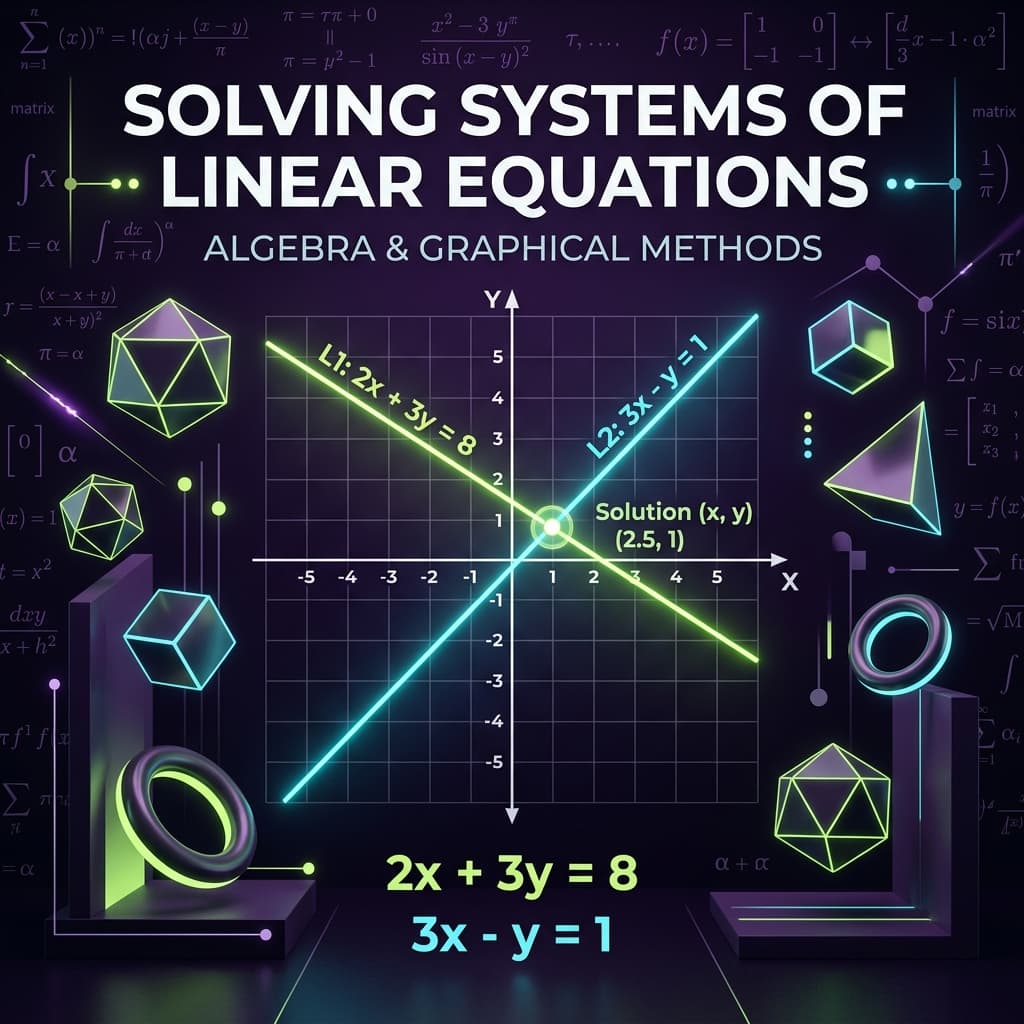
Solving a system of equations can feel like trying to crack a secret code. You have multiple variables, multiple equations, and plenty of room for minor arithmetic mistakes. However, once you learn the core methods—substitution, elimination, graphing, and the matrix method—you will be able to solve any linear system with total confidence.
In this comprehensive guide, we break down each solving method step-by-step with complete algebraic work. You can also use our Math Solver or AI Homework Helper to scan any equation and verify your steps instantly.
What is a System of Equations?
A system of equations is a set of two or more algebraic equations containing the same set of variables. The solution to the system is the specific coordinate pair (or set of values) that satisfies all equations in the system simultaneously. Graphically, the solution is the exact point of intersection where the lines cross.
In standard algebra, we work primarily with linear systems containing two variables (usually x and y):
Equation 2: dx + ey = f
Method 1: Solving Systems of Equations by Substitution
The substitution method is best when one of the equations is already isolated for a variable (e.g. y = 2x + 1), or when it is easy to isolate a variable with a coefficient of 1 or -1.
The Substitution Steps:
- Isolate one variable in either of the two equations.
- Substitute this algebraic expression into the other equation.
- Solve the resulting single-variable equation.
- Plug the numeric value back into the original isolated equation to find the second variable.
- Write your final answer as an ordered coordinate pair: (x, y).
Worked Example:
Solve the following system of linear equations:
2) 3x + y = 11
Step 1: Equation (1) is already isolated for y.
Step 2: Substitute (2x + 1) for y in equation (2):
Step 3: Combine like terms and solve for x:
5x = 10
x = 2
Step 4: Substitute x = 2 back into y = 2x + 1 to find y:
y = 4 + 1
y = 5
Step 5: The coordinate solution is (2, 5).
Stuck on a tricky algebra step?
Scan your equation with Socratic Owl for an instant step-by-step solution with work.
Method 2: Solving Systems of Equations by Elimination
The elimination method (or addition method) is ideal when the coefficients of one variable are already opposites (e.g., +3y and -3y), or can easily be made opposites by multiplying equations by a non-zero integer.
The Elimination Steps:
- Align both equations in standard form: ax + by = c.
- Multiply one or both equations by constants so the coefficients of one variable are opposites.
- Add the two equations together to eliminate that variable.
- Solve the resulting single-variable equation.
- Substitute the value back into either original equation to calculate the remaining variable.
Worked Example:
Solve the following system:
2) 5x - 3y = 6
Step 1 & 2: Equations are aligned, and the y terms (+3y and -3y) are already opposite coefficients.
Step 3: Add both equations to eliminate y:
7x = 14
Step 4: Solve for x:
Step 5: Substitute x = 2 into equation (1) to solve for y:
4 + 3y = 8
3y = 4
y = 4/3
The solution is (2, 4/3) (or approx (2, 1.33)).
Method 3: Solving Systems of Equations by Graphing
The graphing method visualizes linear equations on the Cartesian plane. The solution corresponds directly to the coordinate point where the two lines intersect. This method is excellent for conceptual understanding and checking linear independence.
The Graphing Steps:
- Rewrite both equations in slope-intercept form: y = mx + b.
- Plot the y-intercept (0, b) for each line on a coordinate graph.
- Use the slope m = rise / run to plot additional points and draw straight lines.
- Identify the exact intersection point (x, y) where the lines cross.
- Plug the coordinate back into both original equations to verify accuracy.
Worked Example:
Graph and solve the system:
2) y = -x + 4
Visual intersection of Line 1 (y = 2x + 1) and Line 2 (y = -x + 4) at point (1, 3).
The lines intersect cleanly at point (1, 3). Substituting x = 1 yields y = 3 in both equations, confirming the solution!
Method 4: Matrix Method & Cramer's Rule (Briefly)
When dealing with 3x3 or larger systems of linear equations, paper elimination becomes tedious. Linear algebra solves systems using Augmented Matrices or Cramer's Rule (Determinants):
[ d e | f ]
By applying Gaussian elimination (row reduction to Row Echelon Form) or computing matrix inverses X = A⁻¹ B, matrices allow computer software and advanced calculators to solve systems of dozens of equations in milliseconds!
Method Comparison Table
Not sure which method to pick for your math homework? Use this handy quick-reference comparison:
| Method | Best For | Difficulty | Speed |
|---|---|---|---|
| Substitution | Simple equations where one variable is already isolated (y = mx + b) | Easy | Fast for 2x2 systems |
| Elimination | Standard form equations (ax + by = c) with integer coefficients | Medium | Fastest for most algebra problems |
| Graphing | Visualizing intersection points & checking for real solutions | Easy | Slower (requires precise graph paper) |
| Matrix Method | Large systems (3x3 or higher) & computer algebra solvers | Advanced | Instant via AI / Software |

Solve this exact equation with Socratic Owl
Take a photo of your linear equation or math homework problem and receive an instant step-by-step mathematical breakdown with explanations in seconds.
Common Mistakes to Avoid
Even top math students slip up on algebra tests. Keep an eye out for these frequent mistakes:
- Forgetting negative signs: When distributing minus signs across parenthetical expressions, double check signs (e.g. -3(x - 4) = -3x + 12, NOT -3x - 12).
- Substituting into the same equation: Always plug your isolated variable expression into the other equation, not the one you derived it from!
- Stopping after finding only x or y: A complete solution requires an ordered coordinate pair (x, y). Don't forget to solve for the second variable!
- Arithmetic & fraction errors: Take your time when multiplying equations during elimination to ensure every single term (including the right-hand constant) is multiplied.
- Combining unlike terms: Ensure you only add terms with identical variables (e.g., 3x + 2y cannot be combined into 5xy).
Practice Questions
Test your knowledge! Try solving these three practice problems on paper, then expand to check your work:
x + y = 5
x - y = 1
View Answer & Step-by-Step Solution
Method: Elimination
Add both equations directly: (x + x) + (y - y) = 5 + 1 => 2x = 6 => x = 3.
Substitute x = 3 into 3 + y = 5 => y = 2.
Answer: (3, 2)
2x + y = 7
x - 2y = 1
View Answer & Step-by-Step Solution
Method: Substitution
Isolate y in eq (1): y = 7 - 2x.
Substitute into eq (2): x - 2(7 - 2x) = 1 => x - 14 + 4x = 1 => 5x = 15 => x = 3.
Substitute back: y = 7 - 2(3) = 1.
Answer: (3, 1)
3x + 2y = 12
y = 2x - 1
View Answer & Step-by-Step Solution
Method: Substitution
Substitute eq (2) into eq (1): 3x + 2(2x - 1) = 12 => 3x + 4x - 2 = 12 => 7x = 14 => x = 2.
Find y: y = 2(2) - 1 = 3.
Answer: (2, 3)
? Frequently Asked Questions
How do you solve a system of equations by substitution?
To solve by substitution, first isolate one variable in one equation. Then, substitute that variable's expression into the second equation. This gives you an equation with only one variable, which you can solve. Finally, plug that value back into the first equation to find the second variable.
Can a system of equations have no solution?
Yes! A system of equations has no solution (inconsistent system) when the equations represent parallel lines with the same slope but different y-intercepts. Algebraically, solving yields a false statement like 0 = 5.
Can a system of equations have infinitely many solutions?
Yes! A system has infinitely many solutions (dependent system) when both equations represent the exact same line. Algebraically, solving yields an identity like 0 = 0.
Which method is fastest for solving systems of equations?
Elimination is usually the fastest method when variables are in standard form (ax + by = c). Substitution is fastest when one equation already isolates a variable.
How do you check your answer in a system of equations?
Plug your coordinate pair (x, y) back into BOTH original equations. If both statements hold true, your answer is verified!
What is the best system of equations solver app with work?
Socratic Solver: Homework AI is the top rated mobile app for solving systems of linear equations. It captures printed or handwritten math via camera and returns instant step-by-step work.


